When I lived in Denver, I took watercolor lessons from
Dani Tupper. Dani, an accomplished artist, began taking small groups on Painting Trips Abroad. One of the first, in 1997, was to Spain & Portugal. There were 7 of us...and what a time we had!
The Art Group Goes to Spain~as MaryAnn would say, "We're in Spain, y'all!"
I'd like to share this trip by way of the sketches from my journal.
We landed in Madrid, picked up our rental van then drove to our small pension in Los Hueros, a very small town in the hills outside of Madrid. There was hardly a soul who spoke English but our place was great and everyone so friendly.
The first day was "museum" day. We took the Metro into the city (we parked at the end of the line~at the
Plaza des Toros, the bull ring.) We walked to
Joaquin Sorolla's home with lovely garden.
 |
| Sorolla's home and now museum. |
Sorolla was unfamilar to me but his
paintings are beautiful in the Impressionistic style.
Afterwards, we took the Metro to the Prado where we saw the "highlights" of the Museum. Mostly Flemish and Spanish artists.
Francisco Goya was particularly interesting. He had a long career and his subjects and style changed dramatically with the times and decline of his health.
The next day we visited the Royal Palace and then walked to the very large Plaza Mayor. It is the central plaza of the city surrounded by buildings with porticos. We sat, rested and ate here.
 |
| Plaza Mayor |
After returning to Los Hueros that afternoon, we drove to Torres de Alameda another small village in the hills, where Dani had lived. We stopped and had a sketching session outside the town.
We left Los Hueros the following day and drove through "La Mancha" country; the land of windmills.
We stopped in Chinchon for the Saturday market, then up to Campo de Criptana to see the windmills.
 |
| El molino de viento. Windmill |
We drove the winding road up to the
Castillo de Consuegra, it was very (!) windy. A group of 7 windmills stand on the hill above the castle. We stood below the windmills and sketched; it was hard to keep your balance, it was blowing so hard.
 |
| My painting "Consuegra" from the sketch I made that day. |
We drove on to our next destination, Toledo; the old capital of Spain. Toledo is surrounded almost entirely by the Tajo river, creating a natural moat. My roommate, Ann, and I lucked out and got the "room with a view". The Domenico hotel was on the hillside across the river and our view was looking towards Toledo, which is a beautiful site. I got up early the next morning and made this sketch.
 |
| Toledo from the Hotel Domenico. |
I would have loved to have stayed another day in Toledo. There is much to see. We did tour the
Alcazar, which appears in the upper right in the above sketch. I sat in the courtyard and made the next sketch. I had an audience watching me...it was a bit unnerving.
 |
| The courtyard of the Alcazar. I left the fountain out. |
Heading towards Portugal, we stopped in Caceres, Trujillo, Garrovilla and Merida. Merida was quite interesting. There are many Roman ruins throughout the town. I loved the drive through Spain; it is so pastoral. The countryside is dotted with olive trees, stone fences with wrought iron gates, red poppies in the fields, sheep, goats and ruins here and there. Many photo ops. I must mention that while in Spain, I used every word of high school Spanish that I could remember.
On to Portugal.
On the way towards Portugal we passed a horsedrawn cart with a family of gypsies. Dani had mentioned that we might encounter gypsies on our travels. We stopped to take photos and offered money in return. The family and the horse looked in need of a good meal.
Our first stop was Evora. A beautiful little village on a hill. The streets were very narrow. We made our way up to our hotel which was located on a plaza. After unloading, an attendant took our van to be parked. Not much room for cars here.
 |
| Painted headboards, similar to rosemaling. |
Due to its well-preserved old town centre, still partially enclosed by medieval walls, and a large number of monuments dating from various historical periods, including a
Roman temple, Évora is a UNESCO World Heritage site. It's a wonderful place for walking and exploring and especially nice for artists.
 |
| Looking down one of the narrow alleys in Evora. |
We learned early on that Portuguese, while it looks like Spanish, is totally different in pronounciation (it sounds more like Hungarian). None of our Spanish background helped at all! In the week we were in Portugal, I learned one word~
gelo (ice). We had to buy ice often for our picnic lunches.
We left Evora in the hills and drove down to
Lisbon and the coast. Our time in Lisbon was brief. We drove up to
St. George's Castle, that provides a beautiful view of the city and port. It is a large park in the ruins of the castle, very serene with many little "rooms" to explore. It's described as an "oasis of peace". From the castle we walked down through the
Alfama. It is a village within a city made up of narrow streets, tiny squares, churches, and whitewashed houses with wrought-iron balconies adorned with pots of flowers, drying laundry, and caged birds. When we arrived at the bottom of the hill we had no idea how to get back up to the Castle; so, half the group returned in a taxi to find the van and the rest of us stayed in the beautiful park. We wondered if they would know how to get back down to find us!
I sat and sketched while we waited.
We were picked up, then were off; up the coast to
Estoril, a seaside resort. From there we continued north stopping at
Cabo de Roca, the western most point of continental Europe (click on the site for fabulous photos).
We stopped in
Sintra and toured the
Palacio de Pena; a wonderful castle in the moorish style.
 |
| Placio de Pena~Sintra. |
Obidos, a small quaint whitewashed village with fortified wall was next. It was beautiful! The bright and colorful bougainvillea and geraniums were so dramatic against the white buildings. Obidos would be a wonderful place to stay.
We drove on to the coastal village of
Nazare and saw the fishing boats, the fish drying on racks on the beach, the women gathering in the nets. We ended our day in
Leiria, our resting place for the night. The next day we visited
Fatima. Most notable was seeing people making their way to the apparition sight on their knees. The Basilica was beautiful.
On to
Aviero another city on the coast noteworthy for it's seaport, beaches at Barra, beautiful tile work on the buildings and the canals and
molicieros. Moliceiro is the name given to vessels that circulate in the Ria de Aveiro, the lagoon of the Rio Vouga. This vessel was originally used for harvesting of seaweed, but is now used more for tourism. I was attracted to these colorful boats and tried to get a sketch in the rain...not very successful.
 |
My painting of the "Molicieros" in Aviero.
|
Portugal is so very different from Spain. It is rough and rugged. Leaving the coast we passed marble quarries and even towns that were literally built with marble. Just unbelievable. Cork trees were prevalent too.
Heading west towards Garda we passed through
Luso and the
Bucacao Forest. This place felt mysterious . It was raining so everything was misty and muted ~ethereal. It was one of my favorite sites in Portugal.
 |
| Sketched sitting in the van. This path led into a wall of mist and fog. |
 |
The rain let up a bit and we walked in another area of the forest. This was a beautiful
waterfall/fountain that continued up and up. Fonte Fria. |
 |
This was the rose garden in the Carmelite Convent located in the forest.
I sketched this in a doorway so I wouldn't get wet from the constant showers.
It was a lovely place. |
Our last stop in Portugal was the small town of
Garda. The shopping was fabulous! We had the chance to spend all of our escudos before crossing back into Spain. The Portuguese pottery is so colorful and beautiful.
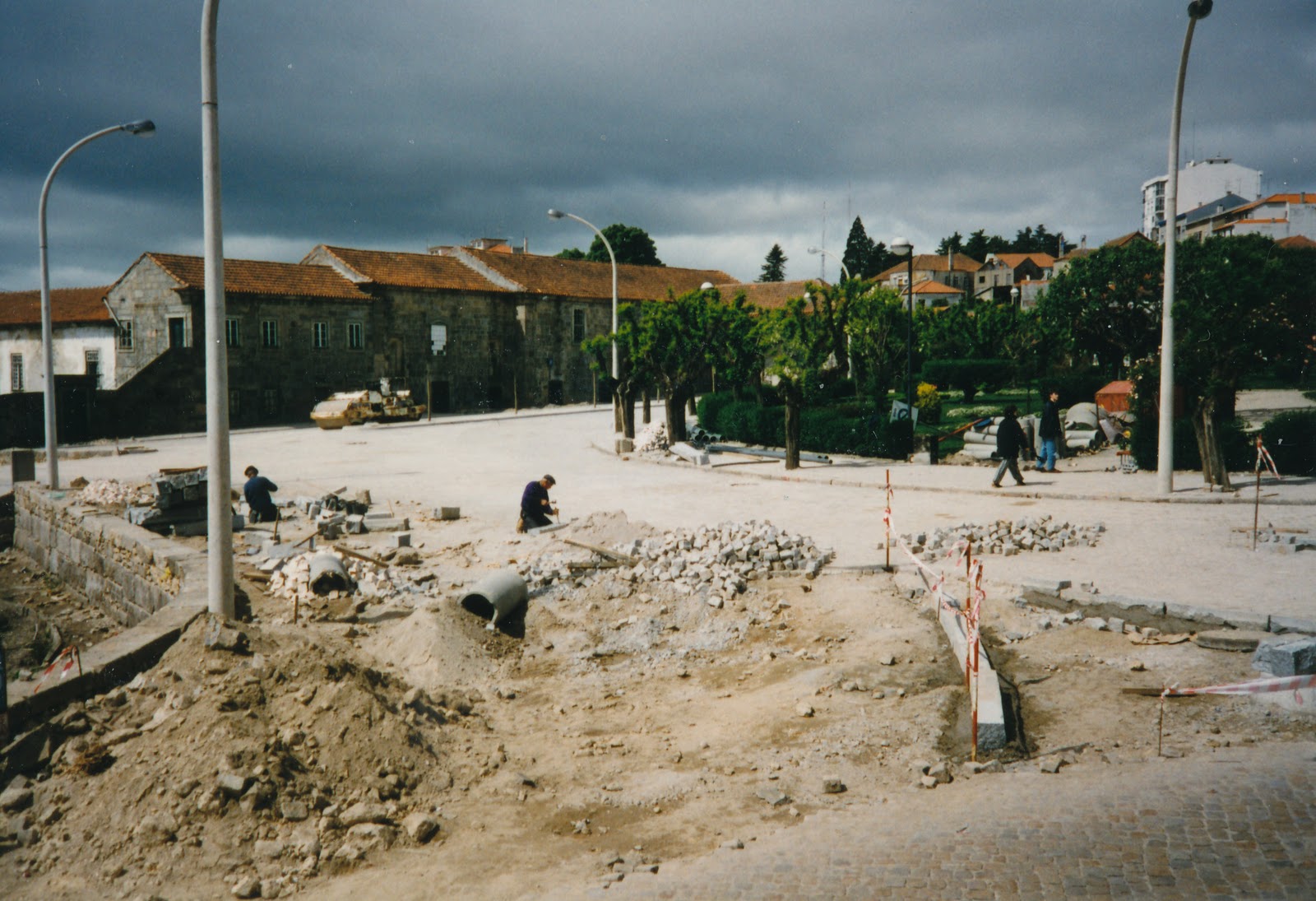
I took this photo before leaving. I was fascinated by this workman.
 |
Workmen repairing the cobbled street, block by block.
|
Making our way back to Madrid, we stopped in the walled town of Avila. That night we arrived in
Segovia.
I loved
Segovia. Our hotel was on the main plaza across from the magnificent Cathedral. It is an easy town to walk around in. The sites are amazing. There is a huge Roman aqueduct, the first I had seen of that size. The Alcazar was beautiful from every view point. We stayed in Segovia 2 days~time for some sketching.
 |
| Sitting at the entrance to the Alcazar. |
 |
The Roman aqueduct.
|
We covered alot of territory in 2 weeks. Spain and Portugal are quite diverse; both were friendly places to visit and very beautiful.
I will remember most the windmills, the red poppies, Segovia and especially making a new friend, Ann.